
I grew up reading hard science fiction. Some of my favorite authors were Arthur C. Clarke, Robert Heinlein, Isaac Asimov, Ray Bradbury, Larry Niven, Frank Herbert, and Jerry Pournelle. All these writers created technically plausible stories with heavy doses of science. I’ve always held that science fiction needs some actual science to distinguish it from fantasy. As the genre matured or degenerated, depending on your viewpoint. The requirement for legitimate science was relaxed. It started with rebranding science fiction as speculative fiction. Speculative fiction is mostly fantasy written by authors who are either hostile or indifferent to science. However you label it, the best science fiction is magnificent. Orwell’s 1984 is so great that the effete literati no longer consider it a lowly sci-fi novel. It’s beyond that. How we classify great stories is irrelevant; they’re great stories.
Sadly, for the not-so-great stories, genre matters. This is why bookstores sort their contents into handy customer-friendly categories like Young Adult, Manga, Fantasy, Non-fiction, etc. Young Adult readers are looking for a particular story; they don’t want to waste their time and money on book-nag-recommended material. Book nags have been around for eons. If you were chastised as a child for reading comic books, you know what a book nag is. No matter your reading tastes, book nags will deem whatever you read low-brow, time-wasting, brain-rotting drivel. I don’t know what book nags read. It’s certainly not graphic novels, westerns, romances, mysteries, how-to-manuals, or anything that might entertain or inform. My advice is to ignore book nags and read what you like, and I like a good dose of hard sci-fi now and then.
My problem, and probably yours, is finding hard, plausible sci-fi in today’s market. Science fiction has changed in recent decades, and not for the better! Nowadays, it is far more important for alleged sci-fi novels to have diverse characters and authors than, you know, good stories. Just sample contemporary book cover blurbs. They’re likely to go on about how the author is gay, black, or trans and how they bravely manifest their truth in their stories. I’m pretty sure Clarke was not manifesting his truth when he wrote Rendezvous with Rama. He was telling a great story, and frankly, you could put a gay chick in Rama, and it would still be a great story. On the other hand, if you replaced the gay and trans characters with normies in many au courant sci-fi novels, you would seldom be left with a great, or even readable, story. Chick substitution does not go both ways.
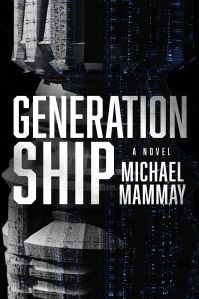
And that brings me to Michael Mammay’s Generation Ship (GS). I hesitated when I spotted Generation Ship in our local Barnes and Noble. I liked the straightforward, nonpretentious title and the subdued cover art, but I was put off by the preamble blurbs that described GS as a riveting, hard sci-fi political page-turner. Anything political is toxic these days. It’s bad enough that I must endure orange morons and demented presidential imbeciles in real life. I don’t want them in my fiction unless they are dying horrific, torturous deaths. I read a few pages of GS in the store, and then I bravely (do we ever do anything that isn’t brave?) decided to risk it. I’m glad I did. Generation Ship is a riveting political page-turner, And here’s the kicker: the book would be worse without the politics.
Generation Ship is about a giant spaceship on a 2½ century-long interstellar voyage to a potentially habitable planet spotted by enormous Sol/Earth system telescopes. Everyone onboard GS was born on the ship, and the original crew has long since died. At least three generations have lived and died on the ship, hence the name generation ship. At this point in the story, the sci-fi is grade-A hard. There are no magic wormholes, faster-than-light engines, cryogenic hibernation pods, antimatter drives, and so on, except for the working fusion propulsion powering the ship; we know how to build a GS right now. Good sci-fi extrapolates actual science. Forecasting fusion propulsion is a leap but a rational one. Wielding wormholes is magical thinking.
The story begins with the ship approaching its long-targeted destination. The author uses the day-by-day arrival countdown to drive the story. The shock of arrival triggers widespread reappraisals of the ship’s many rules and norms. For over two centuries, the inhabitants of GS have lived and died by a rigid set of rules designed to keep the crew and ship smoothly functioning in a severely resource-constrained and deadly situation. Among the many laws we might object to is the requirement that crew members voluntarily euthanize themselves at seventy-five years of age. It sounds harsh, but let’s face it. Seventy-five-year-olds are usually resource deadbeats; they consume more than they produce. This is true even back on real Earth: consider Biden and Trump – yeah, that seventy-five-year age limit isn’t looking so bad, eh?
The GS story kicks into high gear when one seventy-five-year-old woman decides it’s unfair and unjust to self-euthanize with arrival just months away. Why can’t I live to see the planet I have spent an entire lifetime attempting to reach? Besides, the rules are for travel between stars; they must change when the trip ends. I’m going to stop here. Ruining good books should net you prison time, and Generation Ship is excellent hard sci-fi: enthusiastically recommended.


 Analyze the Data not the Drivel